What Is BAC Water — And Why Does It Matter for Peptide Research?
- Golden State BIO
- Jun 25
- 4 min read
Updated: Jun 29

If you've ever ordered a research peptide, you've probably seen "reconstitute with bacteriostatic water" in the instructions. But what actually is BAC water, why does it matter, and what happens if you use something else? This guide covers everything you need to know — in plain terms.
What Is Bacteriostatic Water?
Bacteriostatic water (BAC water) is sterile water for injection that contains 0.9% benzyl alcohol as a preservative. The benzyl alcohol is what makes it "bacteriostatic" — it inhibits the growth of bacteria without killing them outright, which means it can safely preserve a solution over multiple uses without contamination becoming a concern.
This is distinct from regular sterile water for injection (SWFI), which contains no preservative and is intended for single-use only. BAC water, by contrast, is stable for multi-use for up to 28 days once opened when stored correctly.
Why BAC Water Is Used for Peptide Reconstitution
Research peptides are supplied lyophilized — freeze-dried into a powder — for stability during storage and shipping. BAC water is the standard solvent for most peptides for several reasons:
Multi-dose stability: The benzyl alcohol preservative prevents bacterial contamination across multiple draws from the same vial.
Peptide compatibility: The slightly acidic pH of BAC water (typically 4.5–7.0) is well-tolerated by most peptide structures.
Sterility: BAC water is sterile-filtered and produced under pharmaceutical manufacturing standards.
Extended shelf life: Reconstituted peptides in BAC water at 2–8°C typically remain stable for 2–4 weeks.
BAC Water vs. Other Solvents
Sterile water for injection (SWFI): Single-use only — no preservative means unused solution must be discarded after each use.
Normal saline (0.9% NaCl): Can accelerate degradation of some compounds. Not recommended as a default.
Acetic acid solution (0.1–1%): Used for peptides that don't dissolve well in water. Specialized case, not standard.
Tap or non-sterile water: Never appropriate — introduces contamination risk.
How to Reconstitute a Peptide with BAC Water
Swab the rubber stopper on both vials with an alcohol wipe before inserting any needle.
Draw the appropriate volume of BAC water into a syringe based on your target concentration.
Inject BAC water slowly into the peptide vial, aiming at the glass wall to minimize foaming.
Gently swirl — never shake — until the powder is fully dissolved.
Store reconstituted peptide at 2–8°C, away from light.
Calculating Concentration
The volume of BAC water you add determines the concentration. Example: 5mg vial + 1mL BAC water = 5mg/mL (5,000mcg/mL). Add 2mL for 2.5mg/mL. Knowing your concentration is essential for accurate dosing in any research protocol.
What You're Reconstituting Matters Too
See our guide on what peptides are and how they work for foundational context, and our BPC-157 research breakdown for a commonly reconstituted compound.
Frequently Asked Questions: BAC Water and Peptide Reconstitution
What is bacteriostatic water used for?
Bacteriostatic water is used to reconstitute lyophilized (freeze-dried) research peptides and other injectable compounds. Its 0.9% benzyl alcohol preservative makes it safe for multi-dose use from a single vial, unlike plain sterile water which is single-use only.
What is the difference between bacteriostatic water and sterile water?
The key difference is the preservative. Bacteriostatic water contains 0.9% benzyl alcohol, which inhibits bacterial growth and allows multi-dose use for up to 28 days once opened. Sterile water for injection (SWFI) has no preservative and must be discarded after a single use.
How long does reconstituted peptide last in BAC water?
Most peptides reconstituted in bacteriostatic water remain stable for 2–4 weeks when stored at 2–8°C, away from light. For longer storage, aliquot and freeze at -20°C — but avoid repeated freeze-thaw cycles.
How much BAC water should I add to reconstitute a peptide?
The volume depends on your desired final concentration. A common approach: add 1mL of BAC water to a 5mg vial for a 5mg/mL (5,000mcg/mL) concentration. Add 2mL for 2.5mg/mL. Always calculate your target concentration before reconstituting.
Can I use saline instead of bacteriostatic water?
Saline (0.9% NaCl) can be used for single-dose protocols, but it lacks a bacteriostatic preservative making it unsuitable for multi-dose use. Additionally, the ionic environment of saline can accelerate degradation of certain peptides. Bacteriostatic water is the recommended standard.
Does bacteriostatic water go bad?
Unopened, BAC water is stable until the manufacturer's expiration date. Once opened, it should be used within 28 days when stored at room temperature, or longer when refrigerated. Discard if it becomes cloudy or shows particulate matter.
Why do peptides need to be reconstituted?
Peptides are shipped lyophilized (freeze-dried into powder) because this form is far more stable during storage and shipping than a liquid solution. Reconstitution with bacteriostatic water converts the powder back into a stable liquid solution ready for research use.
Get Research-Grade BAC Water from Golden State BIO
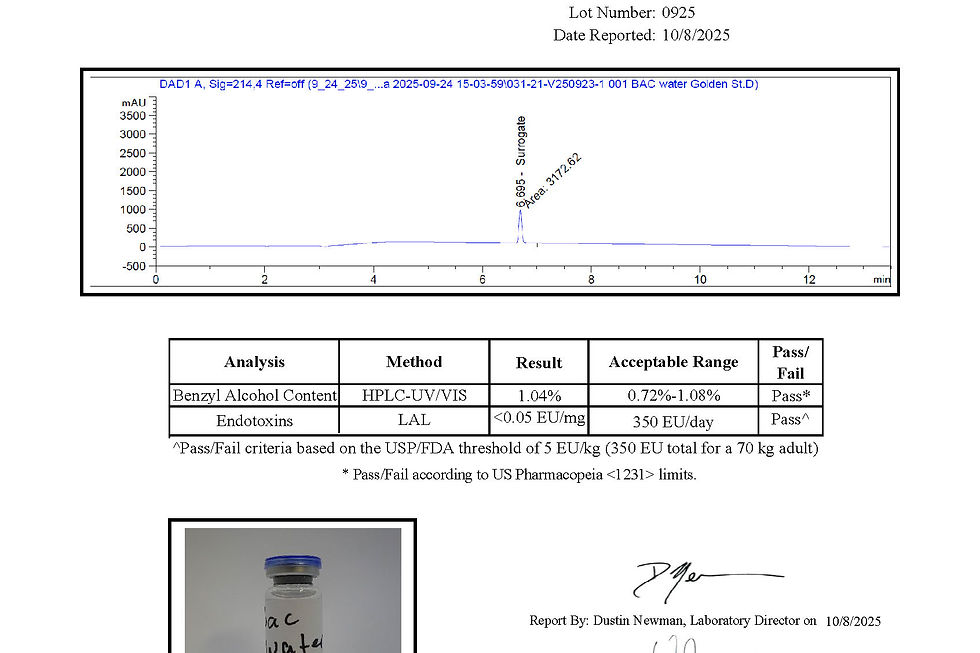
Golden State BIO carries pharmaceutical-grade bacteriostatic water (0.9% benzyl alcohol) for research peptide reconstitution, alongside research supplies including alcohol prep pads and syringes.
The Bottom Line
BAC water is the standard — and for good reason. Its bacteriostatic preservative, sterility, and multi-dose stability make it the right choice for reconstituting the vast majority of research peptides.


Comments